Buying through links on this page may earn Trace & Airframe a commission, and you never pay extra for it. How Trace & Airframe earns affiliate commission
Every remote-controlled aircraft relies on two synchronized elements: the command unit in your hands and the radio frequency (RF) link that translates stick deflections into onboard flight signals. When sourcing a radio transmitter for multirotors, wings, or general radio control models, matching physical form factor to personal handling style is only half the battle. As detailed in the RC Academy radio systems and receivers guide, transmitters and receiver hardware must speak the exact same protocol family, because brand names or chassis designs alone never guarantee interoperability.
Modern radio gear broadly diverges along two design paths: open, low-latency link ecosystems such as ExpressLRS (ELRS) housed inside game-style compact shells, and time-tested, menu-driven box transmitters running proprietary standards like Flysky's AFHDS 2A. Choosing between them determines your receiver selection, onboard wiring footprint, and field portability.
Field Rule: Verify the RF module protocol, receiver wiring interface (such as CRSF/UART versus i-BUS/S.BUS/PWM), and required power source before ordering. Multi-variant marketplace listings frequently offer different receiver packages or internal modules under the same product listing title.
Primary Radio Transmitters Under Comparison
The three listings examined here represent distinct functional tiers for entry-level and compact flight setups: a modern gamepad-style ELRS remote and two traditional dual-stick box consoles.

1. RadioMaster Pocket Crush (2.4GHz ELRS)
The RadioMaster Pocket Crush is aimed squarely at pilots prioritizing field transportability and ultra-low-latency links. Built around a compact gamepad silhouette with a folding antenna structure, it is listed as featuring Hall-effect sensor gimbals and native 2.4GHz ExpressLRS firmware support.
- Stated RF Architecture: 2.4GHz ExpressLRS (ELRS).
- Form Factor: Compact console with integrated display and folding top antenna.
- Control Mechanics: Advertised with Hall-effect sensor gimbals for stick input.
- Best Suited For: FPV drone builders using modern flight controllers running serial CRSF protocols, as well as pilots who pack light or use a thumbing grip style.
- Purchase Verification: Check which specific battery configuration or internal cell holder is included, as compact radios often require separate li-ion cells that may not ship in baseline packages.

2. Flysky FS-i6X (10-Channel AFHDS 2A)
The Flysky FS-i6X represents an updated revision of the classic budget bench transmitter. The listing advertises up to 10 channels operating on Flysky's 2.4GHz AFHDS 2A protocol, packaged with paired receiver options like the iA6B or iA10B.
- Stated RF Architecture: 2.4GHz AFHDS 2A protocol, advertised with 10-channel firmware capability.
- Form Factor: Traditional dual-stick full-size console with monochrome telemetry/setup screen, dual knob dials, and dual toggle switches.
- Receiver Inclusions: Frequently bundled with telemetry-capable receivers like the FS-iA6B or FS-iA10B depending on selected checkout SKU.
- Best Suited For: Fixed-wing foam planes, budget quad training, or robotics projects requiring discrete PWM pin outputs or classic dual-stick ergonomics.
- Purchase Verification: Review the seller's variant dropdown to confirm whether a receiver is bundled and verify which specific model (iA6B vs iA10B) is selected.
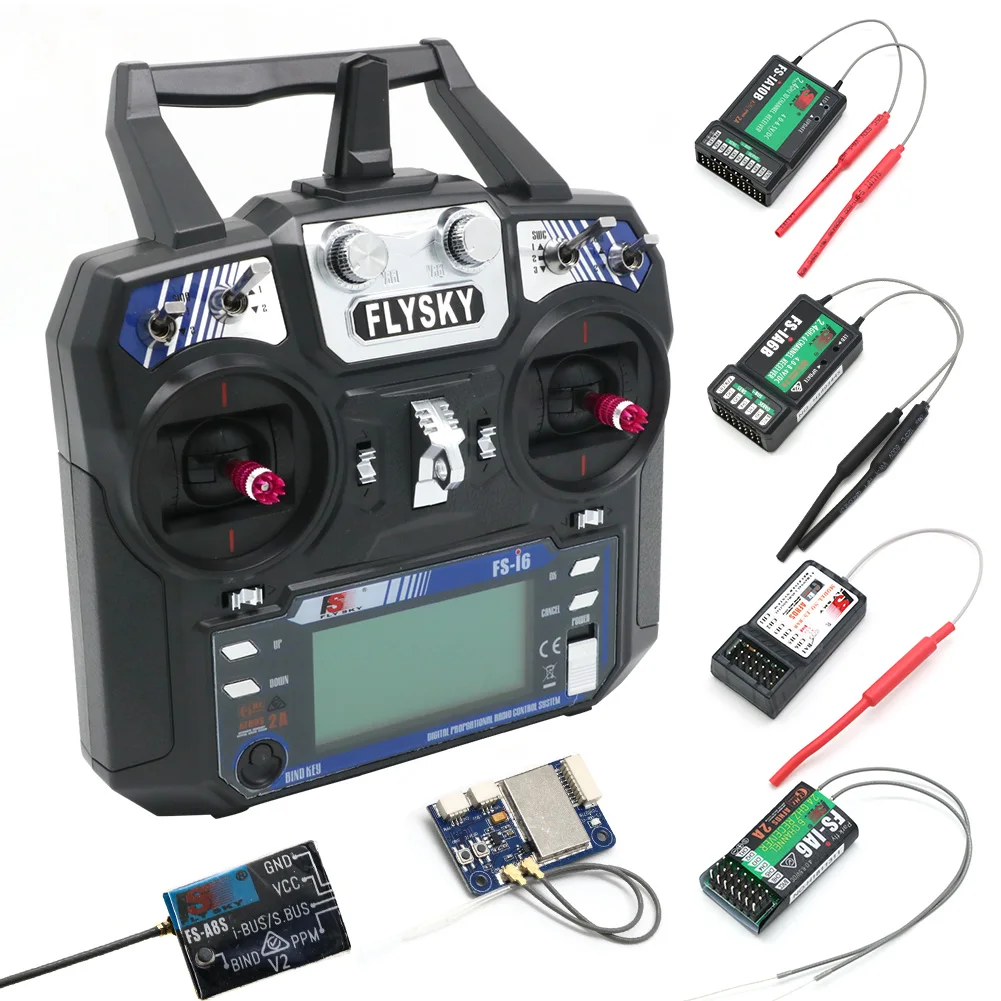
3. Flysky FS-i6 (6-Channel AFHDS 2A)
The original Flysky FS-i6 remains one of the longest-standing entry points into radio control. Stated as a 6-channel 2.4GHz system, this transmitter provides standard physical trim tabs, assignable toggle switches, and an integrated configuration LCD.
- Stated RF Architecture: 2.4GHz AFHDS / AFHDS 2A standard, factory-rated for 6 channels.
- Form Factor: Standard lightweight console housing four AA battery bays (verify battery type with manufacturer documentation before inserting cells).
- Receiver Options: Depicted with various receiver boards (such as micro A8S, X6B, or standard iA6), though bundle contents depend on the exact selected variant.
- Best Suited For: Entry-level flight trainers, low-complexity models needing simple four-channel flight controls plus arming and mode switches.
- Purchase Verification: Confirm if the included receiver supports serial bus outputs (such as i-BUS) or only individual PWM pin headers, particularly if connecting to a multirotor flight controller.
System Differences: Form Factor and Protocol Standards
The core distinction between these options lies in how they integrate with downstream avionics. Traditional systems like the Flysky FS-i6 and FS-i6X communicate over the AFHDS 2A air protocol. In modern FPV drone assembly, this generally pairs with receivers sending i-BUS or PPM data into a flight controller serial port, or driving servos directly through traditional three-pin PWM rows.
In contrast, the RadioMaster Pocket Crush employs ExpressLRS, an open-source high-refresh RC link designed around modern microcontroller UART communication (CRSF). This offers fast packet rates and extensive open-source community firmware updates, but requires the builder to flash matching firmware versions across both the handheld unit and the onboard receiver.
| Parameter | RadioMaster Pocket Crush | Flysky FS-i6X | Flysky FS-i6 |
|---|---|---|---|
| Stated RF Protocol | 2.4GHz ExpressLRS | 2.4GHz AFHDS 2A | 2.4GHz AFHDS 2A |
| Advertised Channel Range | Multi-channel (ELRS firmware defined) | Advertised 10 Channels | Advertised 6 Channels |
| Gimbal Mechanism | Hall Gimbal (seller advertised) | Not specified in listing | Not specified in listing |
| Form Factor | Compact / Gamepad Style | Traditional Box Style | Traditional Box Style |
| Reference Price Range | ~$97.69 (Captured Oct 2026) | ~$62.79 (Captured Oct 2026) | ~$67.59 (Captured Oct 2026) |
Verification Checklist Before Purchase
Because marketplace titles frequently group multiple sub-models and accessory variations together, always inspect the seller's active options and specifications before completing an order:
- Transmitter Operating Mode: Ensure you select the correct stick layout. Mode 2 (throttle on the left stick) is the standard in most multirotor communities, whereas Mode 1 (throttle on the right stick) is preferred by certain traditional RC aviators.
- Included Accessories: Photographs showing four or five different receiver models (such as the FS-iA6, FS-iA6B, and micro A8S) illustrate available manufacturer formats; check the specific product variant line item to confirm which receiver, if any, is in the package.
- Power Supply Requirements: Check manufacturer documentation for exact voltage tolerances and battery dimensions. While traditional box radios often run on standard disposable or rechargeable dry cells, compact units may require unprotected 18650 lithium cells or proprietary lithium packs.
- Destination Delivery & Customs: The items referenced above were verified as available for order across multiple regional marketplaces (including US, MX, CA, CH, BR, KR, JP, and TH as of October 2026). Regional radio frequency regulations or customs policies may govern maximum broadcast power; check your local telecommunications compliance rules before importing high-power transmitters.
Evaluation is based on published specifications and seller listings. No physical or hands-on testing was conducted; unlisted specifications may still be available from the seller.